The Tohoku region remains the ultimate summer destination. If you want to experience the thrill of summer festivals, you cannot miss Akita and Aomori in August, as they are home to the famous Kanto and Nebuta Matsuri. Since the best part of the festivals takes place at night, here is how you can spend your day sightseeing around Aomori in 2026.
Rice field as a canvas
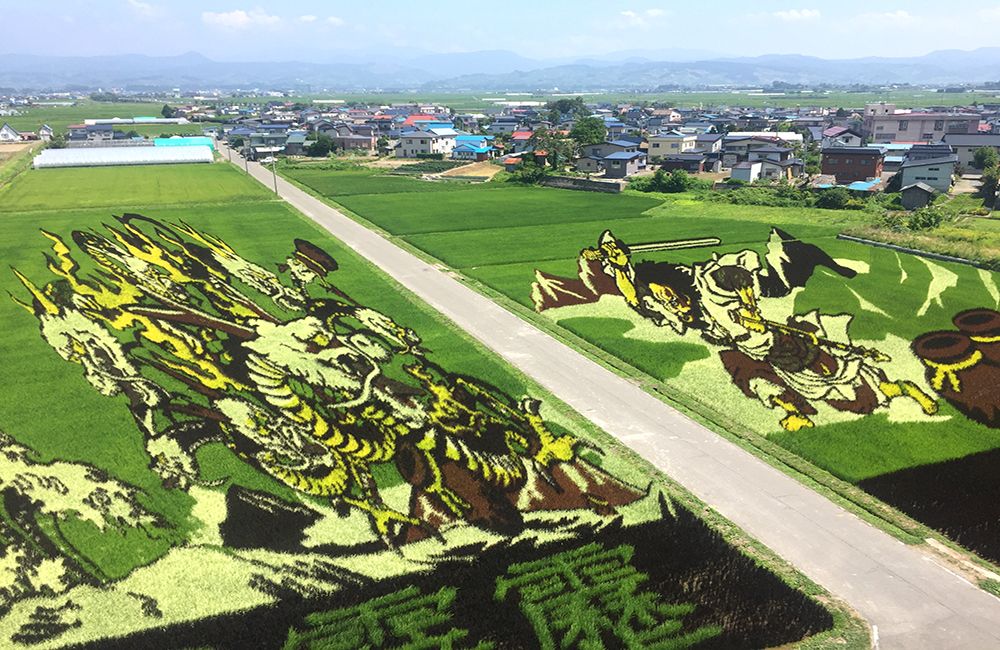
Each year, Inakadate Village creates larger-than-life art pieces using different varieties of the rice plant. Rice Paddy Art, also called Tanbo Art, converts rice fields into massive living canvases.

While the 2017 art represented Astro Boy and Roman Holiday, the 2026 themes (typically announced in late spring) continue the tradition of bringing Japanese folklore and world masterpieces to life.

There are two fields, both with observation decks to get a full view. At first glance, it may seem painted, but a closer look reveals different varieties of rice plants that create the colors naturally.

A shuttle bus is available to go between the two fields.

The fields are ready for viewing at the same time as the Nebuta and Kanto Festivals (late July to mid-August).
The Tanbo Art Station (Konan Railway) is the closest stop and is specially opened during the viewing season.
Gigantic dog in a museum
Once you are done with the fields, head toward Aomori City. Take the “Nebutan-go” loop bus to the Aomori Museum of Art.

(Source: Aomori Museum of Art)
Opened in 2006, at Aomori Museum of Art, you can see an exhibition room of Munekata Shiko, who was born in Aomori prefecture, artworks of Nara Yoshitomo, one of the representative modern artists in Japan, and special creative exhibitions in spacious rooms.

The building itself is one of the highlights and you can check out the gigantic statue of a dog by Nara Yoshitomo, a symbol of this museum, for free! The distinctive building that reminds people of a white box dropped on the trench of an excavation site was inspired by the nearby ancient site of “Sannai-Maruyama.”
Sannai-Maruyama Ruins

Excavated in 1992, Sannai Maruyama Site is the biggest remains of a village dating back to the Jomon period (approx. 5,500-4,000 years ago).

The massive remains contain reconstructions of a large-sized pit dwelling and symbolic three-layered, pillar-supported buildings from the Jomon period. This archaeological site is open to the public all year long.
Colorful Massive Lanterns
Once you are done with the above, you can head back to Aomori Station by bus for the top three festivals in northern Japan, the Nebuta Matsuri.

Held annually from August 2 – 7, gigantic nebuta depicting characters from kabuki, history as well as modern scenes are pulled along a 3-km road with haneto, dancers and musicians, for company. This is one of those once-in-a-lifetime kind of experiences that you definitely don’t want to miss. Since you have traveled all the way, make sure to visit the Kanto Matsuri, one of the top three festivals in the Tohoku region as well.